


October 3, 2026
For single items and photographic prints, DTG usually wins. For bulk runs and exact brand colours, screen printing takes over. A lab study on colour accuracy and durability found screen printing matched specified colours more consistently, measured using the Delta E scale. The right pick still depends on your fabric, order size and colour tolerance.
 That setup cost is the catch. Preparing screens takes time and money regardless of how many shirts you print, so screen printing only pays off once your order reaches a reasonable volume. Below that point, you are paying for screens you barely use.
Where screen printing earns its reputation is colour fidelity and longevity. Spot colour inks sit on top of the fabric in a thick, opaque layer, which holds up to repeated washing and keeps brand colours consistent from shirt to shirt. It is the standard choice for uniforms, event merchandise and any order where an exact Pantone match matters.
Printed apparel is only part of most campaigns. Pennants work well alongside branded tees at sporting events and trade stands, while drape table covers finish off an exhibition stand or registration desk with the same brand colours as your shirts.
That setup cost is the catch. Preparing screens takes time and money regardless of how many shirts you print, so screen printing only pays off once your order reaches a reasonable volume. Below that point, you are paying for screens you barely use.
Where screen printing earns its reputation is colour fidelity and longevity. Spot colour inks sit on top of the fabric in a thick, opaque layer, which holds up to repeated washing and keeps brand colours consistent from shirt to shirt. It is the standard choice for uniforms, event merchandise and any order where an exact Pantone match matters.
Printed apparel is only part of most campaigns. Pennants work well alongside branded tees at sporting events and trade stands, while drape table covers finish off an exhibition stand or registration desk with the same brand colours as your shirts.
TL;DR:
- Screen printing provides more consistent color accuracy and durability, especially on cotton fabrics, making it ideal for bulk orders and brand-specific colors.
- DTG printing is best suited for single items, custom designs, and high-detail artwork like photographs due to its pixel-by-pixel color application and minimal setup costs.
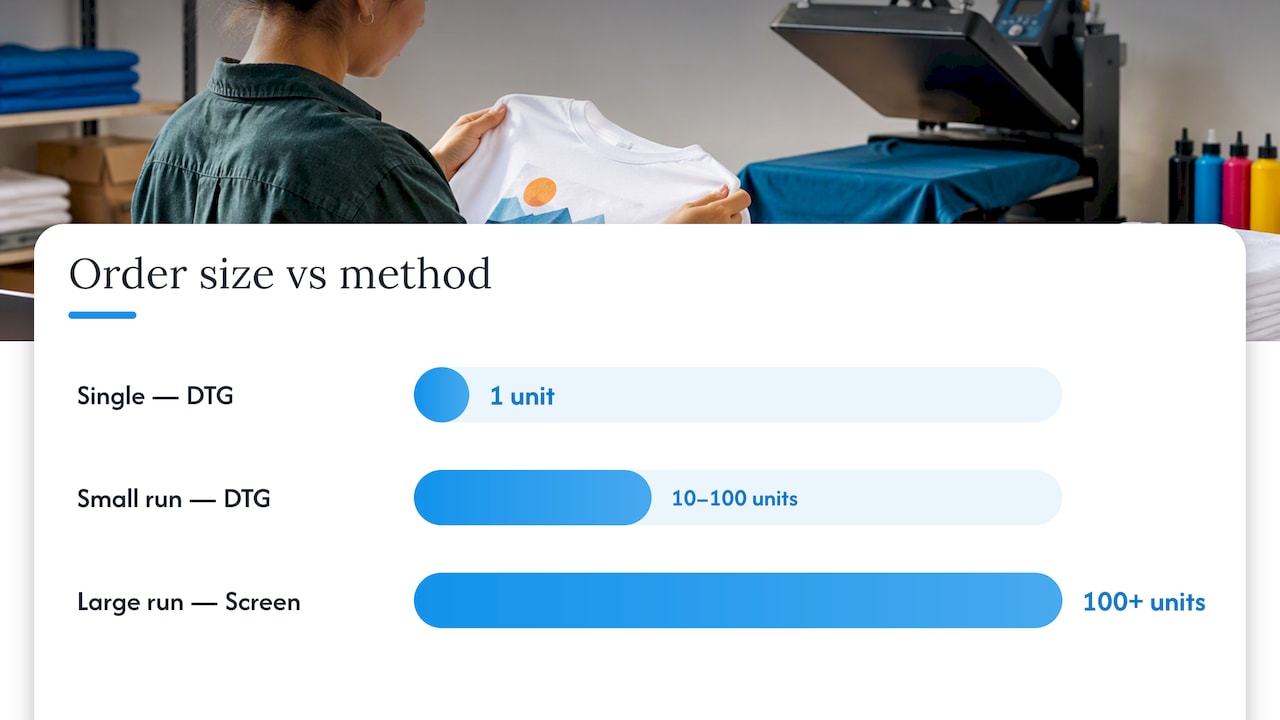
- The cost advantage shifts with order size: DTG is cheaper for small runs, while screen printing becomes cost-effective at quantities over 100 units.
- Fabric choice influences printing method effectiveness: DTG favors polyester and tightly woven fabrics, whereas screen printing handles a wider range of textiles reliably.
- Digital or DTG printing generally reduces water, energy, and chemical use, offering a more sustainable option, especially at small scales or on demand.
Table of Contents
- What is direct-to-garment printing and when to use it
- What is screen printing and when to use it
- Key differences: cost, quality, durability, fabric and sustainability
- When to choose which: a decision checklist and sample scenarios
- Why trust this guide: credentials behind these recommendations
- Common trade-offs and practical compromises
- Services exist to support your printing method choice. Free artwork design can help files print cleanly on DTG, express services cover small urgent batches, and volume quotes may offer cost advantages on bulk screen printing orders.
- FAQ
What is direct-to-garment printing and when to use it
DTG printing works like an inkjet printer for fabric. The machine lays a white ink underbase on dark garments first, then prints the design directly onto the fibres in full colour. There are no screens to prepare and no minimum order to hit before it makes financial sense. This makes DTG the practical choice for anyone who needs just one shirt, a handful of samples, or a print-on-demand product line. Photographic images, gradients and detailed artwork reproduce well because the printer applies colour pixel by pixel rather than through flat layers of ink. DTG mechanics and typical use cases are explained well by Shopify Australia, which also notes that DTG stays cost-effective for short runs because setup costs are minimal. The trade-offs show up at scale. DTG printers process one garment at a time, so large orders take longer than screen printing’s batch process. Cotton blends print more reliably than tightly woven synthetics, and colour accuracy can shift depending on the fabric.- DTG suits single items, custom orders and photo-quality artwork.
- It has no setup cost, so small runs stay affordable.
- Throughput drops on bulk orders compared with screen printing.
- Fabric choice affects colour accuracy, more so on cotton than polyester blends.
What is screen printing and when to use it
Screen printing pushes ink through a stencil, one screen for each colour in the design. A shirt with three spot colours needs three screens, each aligned and printed in sequence using plastisol or water-based inks. Once those screens are set up, printing runs fast and the per-item cost drops sharply.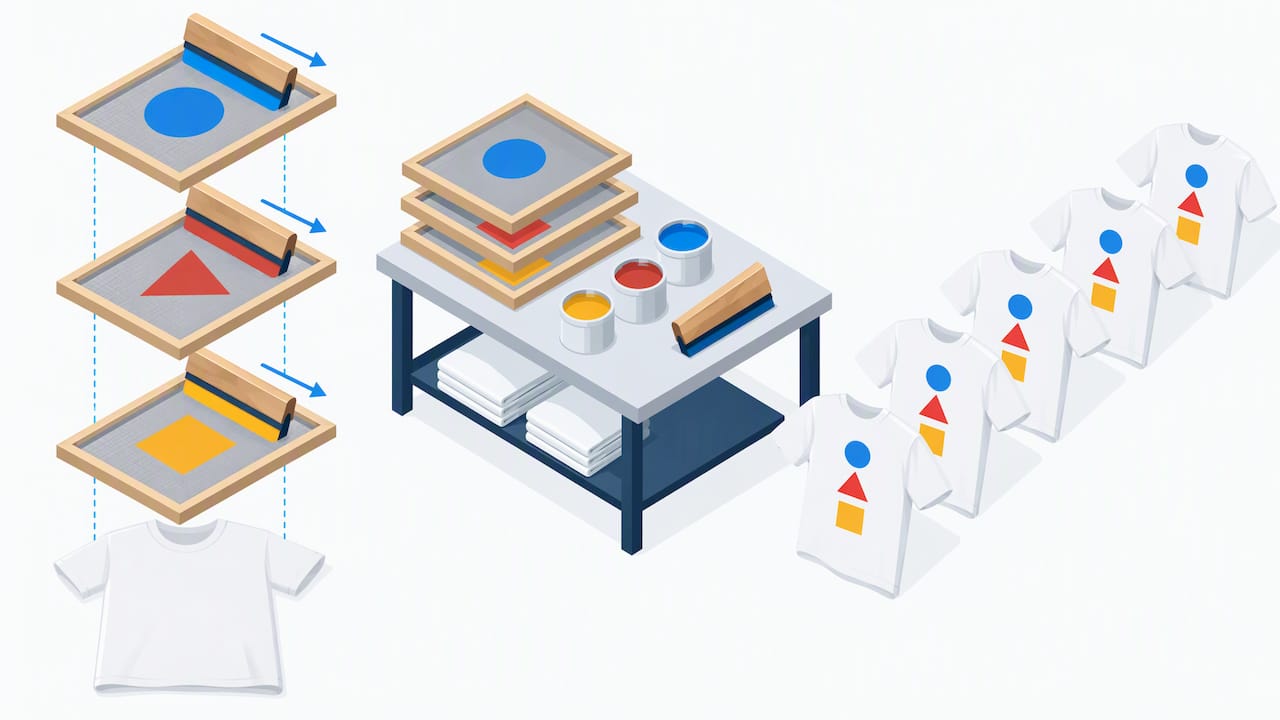 That setup cost is the catch. Preparing screens takes time and money regardless of how many shirts you print, so screen printing only pays off once your order reaches a reasonable volume. Below that point, you are paying for screens you barely use.
Where screen printing earns its reputation is colour fidelity and longevity. Spot colour inks sit on top of the fabric in a thick, opaque layer, which holds up to repeated washing and keeps brand colours consistent from shirt to shirt. It is the standard choice for uniforms, event merchandise and any order where an exact Pantone match matters.
That setup cost is the catch. Preparing screens takes time and money regardless of how many shirts you print, so screen printing only pays off once your order reaches a reasonable volume. Below that point, you are paying for screens you barely use.
Where screen printing earns its reputation is colour fidelity and longevity. Spot colour inks sit on top of the fabric in a thick, opaque layer, which holds up to repeated washing and keeps brand colours consistent from shirt to shirt. It is the standard choice for uniforms, event merchandise and any order where an exact Pantone match matters.
- Screen printing suits bulk orders where per-unit cost needs to fall.
- Spot colour inks give the most reliable brand colour match.
- Setup cost makes small runs expensive relative to DTG.
- Complex photographic designs are harder and costlier to reproduce than with DTG.
Key differences: cost, quality, durability, fabric and sustainability
The cost curves cross at a point, not at a fixed number. DTG has near-zero setup cost and a flat per-item price, while screen printing has a higher setup cost that gets spread across every unit printed. As the order grows, screen printing’s per-item cost keeps falling while DTG’s stays roughly the same, which is why bulk buyers lean toward screens and one-off buyers lean toward DTG. Colour accuracy follows a similar pattern. The imaging study on colour and durability tested screen printing, DTG and dye sublimation across cotton, polyester and blended fabrics using Delta E measurements and wash cycle testing. Screen printing produced the most accurate and consistent matches to specified brand colours across all three fabric types. DTG performed well on polyester and blends but showed colour shift on some cotton samples, which matters if your brand guidelines specify an exact shade. Screen printing delivered the closest colour match to brand specifications across fabric types in controlled Delta E testing, while DTG’s accuracy varied more by fabric. For a logo that has to look identical on every shirt, that gap is worth planning around. Durability tells a related story. Screen printing’s thicker ink layer tends to hold up through more wash cycles before fading, particularly on cotton. A separate experiment on DTG printing on knitted T-shirts found pigment-based DTG inks achieved colour fastness ratings of 4 to 5 and only small changes to fabric mass and strength, which is solid performance but still a different durability profile to screen print’s heavier ink deposit. Fabric compatibility runs in opposite directions for each method. DTG favours polyester blends and cotton with a tighter weave, while screen printing works across a wider range of fabrics without the colour shift risk DTG shows on some cottons. If your garment range mixes fabrics, that difference alone can decide the method. Sustainability adds another layer to the decision. A production case study comparing rotary-screen and digital textile printing found substantial reductions in water, chemical and energy use for digital printing at the scale studied. Separately, industry commentary on digital textile printing points to reduced water use and faster on-demand local production as a practical benefit for smaller brands.- Per-item cost favours DTG at low volumes and screen printing at high volumes.
- Colour accuracy favours screen printing, especially on cotton.
- Durability tends to favour screen printing’s thicker ink deposit.
- Fabric compatibility favours DTG on polyester, screen printing across more fabric types.
- Water and chemical use tends to be lower for digital printing methods like DTG.
When to choose which: a decision checklist and sample scenarios
Before you commit to either method, run through a short checklist. Order size, artwork complexity, how strict your brand colour requirements are, fabric type, budget and turnaround time all point you toward one method or the other.- Check your order size: under roughly 50 units generally favours DTG, over 100 generally favours screen printing.
- Check artwork complexity: photographs and gradients favour DTG, flat spot colours favour screen printing.
- Check colour tolerance: an exact Pantone match favours screen printing.
- Check fabric: polyester and blends favour DTG, varied or heavier cotton favours screen printing.
- Check timeline: DTG suits tight deadlines and on-demand needs.
Why trust this guide: credentials behind these recommendations
This guide is informed by independent evidence including Delta E colour testing, wash cycle studies and sustainability comparisons between digital and screen methods.- Over 25 years of experience across DTG, screen printing and other decoration methods.
- Free artwork design support to help your file meet each method’s requirements.
- Express service for buyers who need samples or small runs turned around quickly.
- A Price Beat Guarantee on quoted orders, so cost comparisons stay straightforward.
Common trade-offs and practical compromises
Most small businesses start with a DTG sample to validate a design, then move the winning artwork to screen printing once volume justifies it. Premium brand colour matches are the exception: if your logo has a strict Pantone requirement, screen printing’s spot inks are worth the setup cost from the first run.— PromoShop
Services exist to support your printing method choice. Free artwork design can help files print cleanly on DTG, express services cover small urgent batches, and volume quotes may offer cost advantages on bulk screen printing orders.
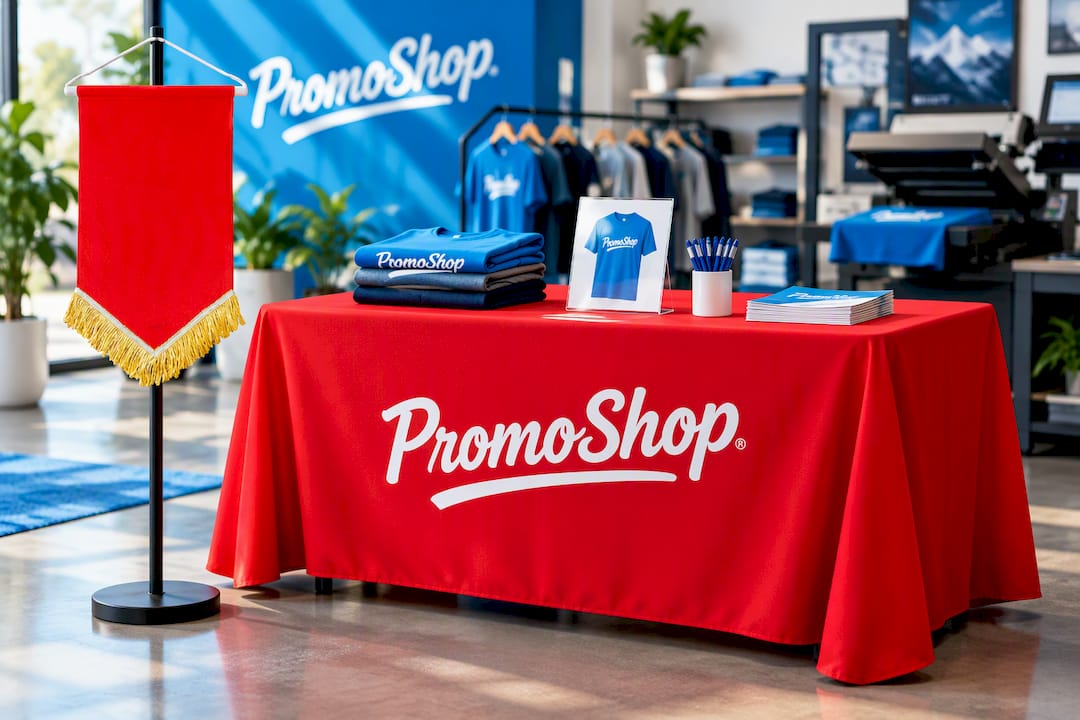 Printed apparel is only part of most campaigns. Pennants work well alongside branded tees at sporting events and trade stands, while drape table covers finish off an exhibition stand or registration desk with the same brand colours as your shirts.
| Need | PromoShop service |
|---|---|
| Photo-quality single item or sample | Free artwork design |
| Small urgent batch | Express Service |
| Bulk order with exact colours | Volume quote with Price Beat Guarantee |
- Request a quote for your order size and fabric.
- Upload your artwork for a free design check.
- Ask for a sample and wash test before full production.